Can You Switch Car Insurance Mid-Policy? Steps, Costs, and Common Mistakes
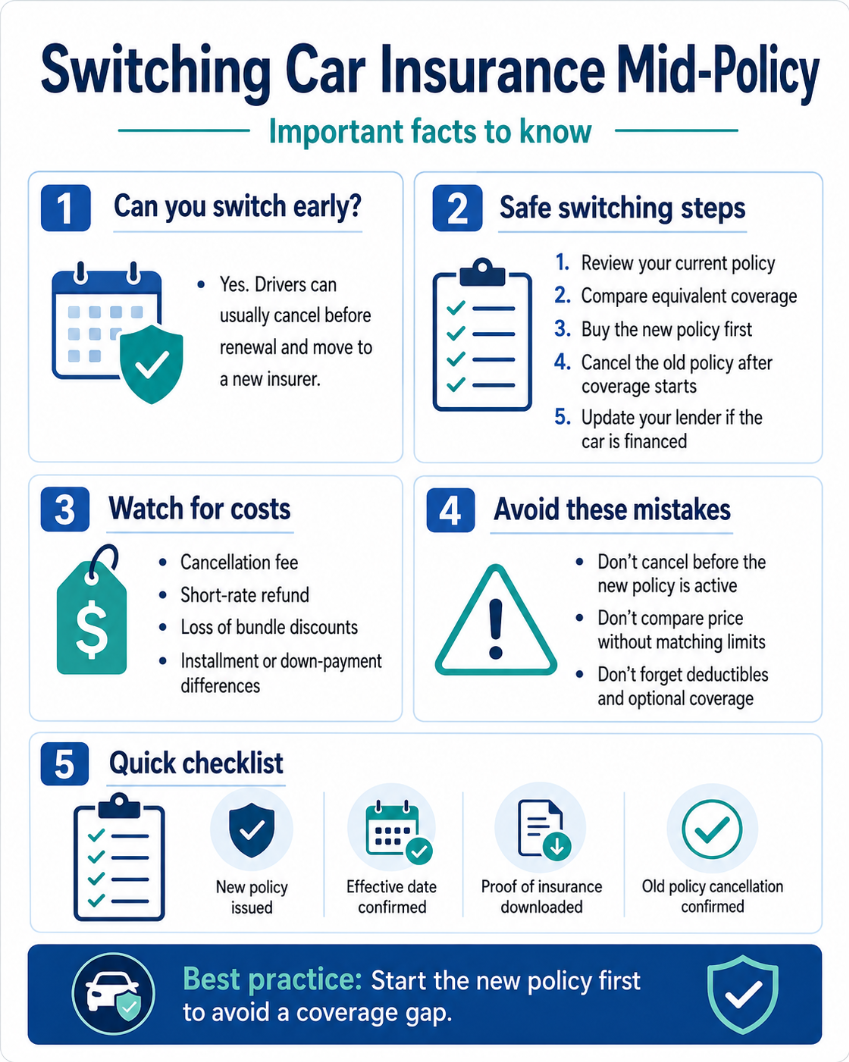
Car insurance is not a contract which has to be always under the same company up to the renewal date. Although drivers may usually cancel a personal auto insurance policy prior to its maturity and use it in another insurer. The safe switching is however than merely locating cheaper monthly price and terminating the previous policy.
A change that does not coordinate well may cause a lapse in cover, leave a funded vehicle without the cover as demanded by the lender or even impose arbitrarily high cancellation fees. This is to ensure that the right coverage is obtained before discontinuing the old policy until the new policy is obtained.
This guide outlines the situations in which drivers can change insurers, what they should compare, how to align the effective dates, and what errors can cause otherwise very simple change to be more costly.
Can You Change Car Insurance Before the Policy Expires?
In the majority of cases, a policyholder will be able to cancel auto insurance policy prior to the date when it is supposed to be expired. According to the National Association of Insurance Commissioners or NAIC, policyholders can cancel their coverage before the term of the policy lapses but the insurer can impose certain cancellation procedures.
This implies that drivers will not always be required to have a renewal date of six months or a year. After a certain period a mid-policy change could be appropriate:
- A substantial premium increase
- Moving to a different state or ZIP code
- Buying or replacing a vehicle
- Adding a teen or another household driver
- Getting married
- Changes in annual mileage or commuting habits
- Receiving poor customer service
- Finding comparable coverage at a more competitive price
- Losing a discount with the current insurer
Though the switching is generally allowed, the financial implications are depended on the policy and the insurer, and the state insurance regulations. Policyholders must inquire about whether they are charged a cancellation fee or a short-rate calculation or a prorated refund before cancellation.
Is It Better to Switch at Renewal?
At renewal, it may be easy to change companies as it provides a natural point of transition. The current policy is terminated and the new one starts on the same day and decreases the amount of billing and refund cases which can be to be solved.
Nevertheless, renewal is not a good time to all drivers. It might not be reasonable to wait several months when the existing premium is no longer affordable or when the policy does not offer suitable protection anymore.
It should depend upon the overall financial difference and not only the timing. An illustration would be the saving of 60 per month now that has four months to go versus a small cancellation fee. Conversely, a marginal increase in premium might not yield a worthwhile reduction in a valuable package, a loyalty allowance, an accident-forgiveness clause or a decreasing deductible.
Ask the existing insurer to cancel the terms of cancellation to make the ultimate decision.
Compare Equivalent Coverage, Not Just the Premium
A low quote does not necessarily mean a superior insurance cover. The quote could be less expensive due to lower liability limits, increased deductibles, or fewer optional coverages in one company as compared to another.
The NAIC suggests that one should evaluate the auto insurance offers by comparing the same or similar limits, deductibles, and coverage types.
Use the following comparison checklist:
| Policy feature | Current policy | New quote |
| Bodily injury liability limits | Review declarations page | Match or compare carefully |
| Property damage liability | Confirm current limit | Check new limit |
| Uninsured/underinsured motorist coverage | Included or declined | Included or declined |
| Personal injury protection or medical payments | Check state-specific coverage | Compare equivalent protection |
| Collision deductible | Record the amount | Compare the same deductible |
| Comprehensive deductible | Record the amount | Compare the same deductible |
| Rental reimbursement | Check daily and maximum limits | Confirm whether included |
| Roadside assistance | Confirm benefits | Compare service limitations |
| Custom equipment coverage | Review endorsements | Verify replacement coverage |
| Total policy premium | Include all installments | Compare the full-term cost |
Drivers should also verify that every household driver and vehicle is included correctly. Incomplete or inaccurate information can produce a quote that changes after the insurer verifies driving records, vehicle information, garaging address, or claims history.
How to Switch Car Insurance Without Creating a Coverage Gap
The safest approach is to complete the switch in a specific order.
1. Review the Existing Policy
Start with the declarations page. This document normally summarizes:
Covered vehicles
Listed drivers
Liability limits
Deductibles
Optional endorsements
Discounts
Policy dates
Lienholder or leasing-company information
Total and installment premiums
The declarations page provides the baseline needed to request comparable quotes.
2. Obtain Several Comparable Quotes
Provide the same driver, vehicle, mileage, address, and coverage information to each company. Comparing inconsistent information can make one quote look artificially inexpensive.
Price is important, but it should not be the only consideration. Drivers may also research whether an insurer is licensed in their state and review available complaint information through their state insurance department or the NAIC’s consumer resources.
3. Review the New Policy Before Paying
A quote is not always the same as a final issued policy. Before completing the purchase, confirm:
The exact effective date and time
All covered drivers and vehicles
Coverage limits and deductibles
Exclusions or special restrictions
The full policy premium
The initial payment
Installment fees
Automatic-payment requirements
Discounts and the conditions for keeping them
Required proof of prior insurance
Lender or leasing-company information
Do not assume that a benefit included with the current insurer is automatically included in the replacement policy.
4. Purchase the Replacement Coverage First
The new policy should be active before the old policy is canceled. Drivers looking for a more detailed sequence can review these steps for switching car insurance providers before coordinating the two policies.
Ideally, the new policy should begin at the exact time the existing policy ends. A brief overlap is generally safer than a gap, but policyholders should confirm the effective times with both companies rather than relying only on the dates shown in an online account.
5. Cancel the Old Policy
Once the replacement coverage has been issued and proof of insurance is available, contact the former insurer. Follow its cancellation procedure, which may require a signed request or confirmation of the requested termination date.
Ask for written confirmation showing:
Policy number
Cancellation date and time
Final amount owed
Expected refund, if applicable
How and when the refund will be issued
Do not simply stop making payments. Failure to pay may cause the policy to be canceled for nonpayment rather than canceled at the policyholder’s request. That can create billing problems and may affect how the interruption appears in insurance records.
6. Update the Lender or Leasing Company
Contractual insurance is typically required by the drivers financing or leasing a car. The lender might insist on collision and comprehensive cover besides state liability insurance.
The Consumer Financial Protection Bureau states that a lapse in the coverage required results in an auto lender obtaining force-placed insurance and billing it to the borrower.
Make the lender or leasing company promptly informed on the new policy. Ensure that it is duly registered as the lien holder or loss payee.
7. Replace Insurance Documents
Get the new insurance identification cards by download or print. Refill any electronic wallet, phone application, glove-compartment copy or paper given to a home driver.
Evidence of coverage might also be reported electronically to the motor vehicle agency depending on the state. The drivers are supposed to comply with the state motor vehicle authority and insurance department.
Will the Former Insurer Refund the Unused Premium?
A pre-paid driver can be refunded the unused amount of the policy, though it is not necessarily the same.
The refund amount received in case of pro rata is usually the amount of premiums returned with regard to the unused time period of the policy.
Short rate refund enables the insurance company to maintain another sum of unearned premium. An example here is the Department of Financial Services of New York that cautions consumers to watch out of insurers that may use a short-rate calculation when a policyholder cancels prior to the expiry date.
Cancellation terms vary by state and policy. Before switching, ask the current insurer:
- Is there a cancellation fee?
- Will the refund be calculated pro rata or short rate?
- Is any installment balance still due?
- Will a bundle discount be removed from another policy?
- How long will the refund take?
- Will the refund return to the original payment method?
Drivers with bundled auto and home or renters insurance should request updated pricing for the remaining policy. Removing the auto policy may reduce a multiline discount and increase the cost of the other coverage.
What Happens to an Existing Claim?
Changing insurers does not normally transfer an existing accident to the new company. A claim is generally evaluated under the policy that was active on the date the covered loss occurred, subject to the terms, exclusions, limits, and claims investigation under that policy.
Policyholders should continue communicating with the insurer handling the claim and preserve relevant documents. Switching companies should not be used as a reason to omit an accident, claim, ticket, or household driver from a new application.
Insurance applications should be completed truthfully. A premium based on incomplete information may be revised, and material misrepresentations can create serious coverage problems.
Common Mistakes to Avoid
Canceling Before the New Policy Is Issued
A quote, application, payment screen, or temporary confirmation may not always mean that coverage has been fully issued. Obtain an effective policy number and proof of insurance before canceling the existing policy.
Comparing Different Liability Limits
A quote with state-minimum liability coverage cannot be fairly compared with a policy carrying substantially higher limits. The lower premium may reflect significantly less financial protection.
Choosing a Deductible That Is Too High
Higher collision and comprehensive deductibles can lower premiums, but the policyholder must be able to pay that amount after a covered loss. The NAIC notes that higher deductibles generally reduce premiums, but consumers should evaluate what they could reasonably pay out of pocket.
Forgetting About Bundle Discounts
Moving only the auto policy can increase the price of a homeowners, renters, condo, or umbrella policy left with the previous company. Compare the total household insurance cost before separating bundled policies.
Ignoring Lender Requirements
Removing collision or comprehensive coverage from a financed vehicle may violate the loan agreement even if the driver still satisfies the state’s minimum liability law.
Allowing Automatic Payments to Continue Unchecked
Do not immediately block payments without reviewing the final bill. Instead, obtain cancellation confirmation, verify any remaining balance, and monitor the account for the promised refund or final authorized payment.
Focusing Only on Monthly Payments
Installment amounts can hide differences in down payments, billing fees, policy-term length, and total premium. Compare the full six-month or annual cost whenever possible.
When Switching May Not Produce Real Savings
A new quote may appear attractive but become less favorable after:
- Losing a multiline discount
- Paying a cancellation fee
- Making a larger initial payment
- Increasing deductibles
- Reducing liability limits
- Removing rental reimbursement or roadside assistance
- Losing a loyalty-related feature
- Changing from a 12-month policy to a six-month policy
- Receiving a revised premium after underwriting review
Calculate the net cost for the entire policy term. The best choice is not necessarily the company offering the lowest advertised payment; it is the policy that provides suitable protection at a sustainable total price.
Final Switching Checklist
Before ending the old policy, confirm that:
- The replacement policy has been issued.
- The effective date and time are correct.
- Drivers and vehicles are listed accurately.
- Liability limits and deductibles have been reviewed.
- Required collision and comprehensive coverage are included.
- The lender or leasing company is listed correctly.
- Proof of insurance is available.
- The former insurer has received the cancellation request.
- Written cancellation confirmation has been obtained.
- Any refund or final balance is documented.
- Other bundled policies have been repriced.
- Automatic payments and online accounts have been reviewed.
Final Thoughts
Drivers can usually switch car insurance before renewal, but the change should be treated as a coverage decision rather than a simple price change. Comparing equivalent policies, activating the replacement coverage first, documenting the cancellation, and notifying any lender can help prevent gaps and unexpected expenses.
Insurance laws, cancellation rules, required limits, and refund practices differ by state. Consumers with questions about their rights, an insurer’s cancellation calculation, or a disputed charge can contact their state department of insurance for state-specific assistance.
This article provides general educational information and is not legal, financial, or individualized insurance advice. Coverage availability, requirements, pricing, and cancellation rules depend on the policy, insurer, vehicle, and state.